


Former Lagos State Governor Babatunde Fashola has drawn a sharp contrast between the records of the Peoples Democratic Party and the All Progressives Congress, arguing that the PDP spent scarce national resources sustaining fuel subsidies while the APC delivered major infrastructure projects and reforms.
Speaking in an exclusive interview with ARISE News, Fashola said the subsidy system operated under previous administrations consumed foreign exchange that could have been deployed to expand Nigeria’s productive and industrial capacity.
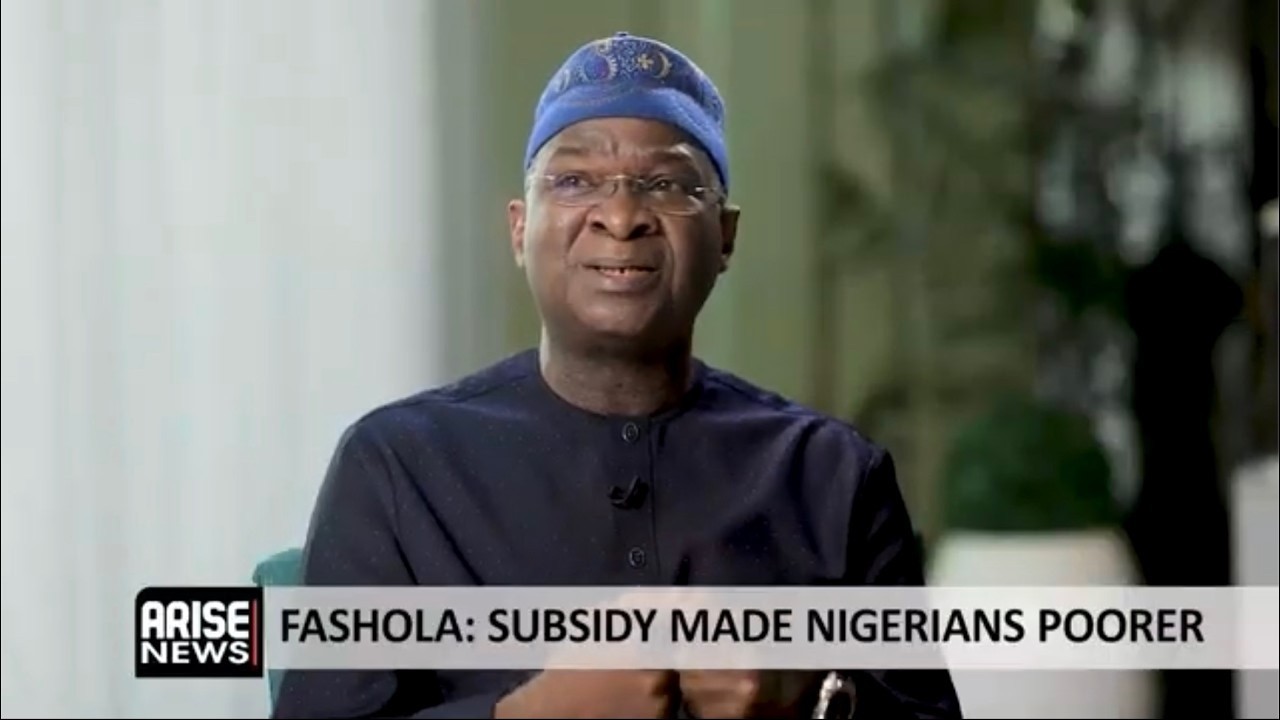
“That administration ran a subsidy scheme that was impoverishing people in a way that they probably didn’t come to terms with,” Fashola said.
“Because all our foreign exchange income was spent not on developing the economy, not on expanding its productive or industrial needs, but on paying for fuel.”
Fashola, who served as Minister of Power, Works and Housing under former President Muhammadu Buhari, said the consequences included rising debt and government revenues being consumed by subsidy payments rather than investment in other sectors.
He contrasted that record with what he described as the APC’s delivery of major infrastructure projects that had remained unresolved for years.
“Big infrastructural ticket items, rail, major roads, the Second Niger Bridge that was a topical issue in every election cycle — all of these problems were solved under an APC government,” he said.
“A new port for this country was built under an APC government.”
Fashola said improvements to infrastructure serving Nigeria’s ports had directly affected traders, importers, exporters and industrialists whose businesses depend on the movement of goods.
He also cited the revival and expansion of rail transportation as evidence that the APC had tackled infrastructure bottlenecks with wider economic consequences.
“Rail transport in Nigeria, solved by an APC government, and that is helping businesses, that is helping people, that is helping the movement of goods and services that are needed,” he said.
Fashola said the distinction extended beyond physical infrastructure to major legislation, pointing to the Petroleum Industry Act, which was enacted under the Buhari administration after years of unsuccessful attempts to reform the petroleum sector.
He argued that the legislation had helped restore confidence in the industry and establish a framework for greater investment.
Fashola also rejected arguments that the current cost-of-living crisis could be attributed solely to APC policies, pointing to the economic disruption caused by the COVID-19 pandemic and subsequent global shocks.
But he acknowledged that Nigerians were experiencing hardship, while maintaining that government policy should be judged by whether it addressed the structural problems facing the economy.
For Fashola, the comparison between the PDP and APC ultimately came down to what each party had done with the opportunity to govern.
“In terms of differential ideology, performance over a relatively shorter period, we have solved some of the biggest problems in Nigeria’s household,” he said.
Demola Ojo
Follow us on:


