


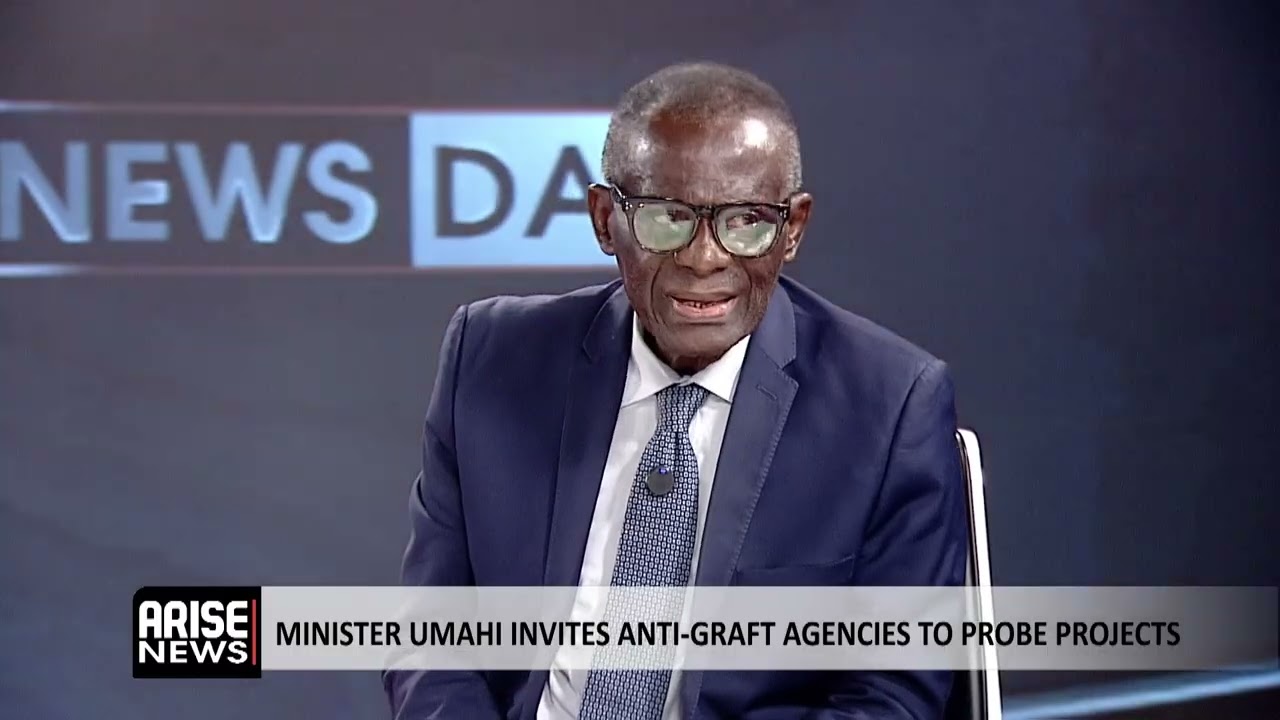
ARISE news analyst, Dayo Sobowale, has described the decision by Nigeria’s Works Minister, David Umahi, to invite anti-corruption agencies to probe road projects as a commendable step toward transparency and accountability.
Speaking during an interview on ARISE News on Thursday, Sobowale said the move reflects a willingness by the minister to open up government projects to scrutiny and rebuild public trust.
Umahi had earlier announced that the Independent Corrupt Practices and Other Related Offences Commission (ICPC) and the Economic and Financial Crimes Commission (EFCC) had been formally invited to investigate both the documentation and physical execution of federal road projects across the country.
According to Sobowale, such a move is not only bold but necessary in a democratic setting where accountability should be prioritised.
“Here is a minister of works in Nigeria saying that there’s nothing to hide. It is to be admired and encouraged,” he said.
He noted that while Nigeria’s governance system is not perfect, efforts like this signal progress toward reducing corruption in public service.
“It’s not that the system is perfect… but we are doing our best. This action is a step towards getting Nigeria less corrupt,” he added.
Sobowale emphasised that the initiative should not be politicised but rather supported, especially given longstanding concerns about abandoned or poorly executed infrastructure projects across the country.
“Several times some of us travel and you don’t get to where you’re going because the roads are not there, and nobody is responsible,” he said.
On concerns about whether anti-corruption agencies possess the technical expertise to audit complex engineering projects, Sobowale dismissed such doubts.
He argued that agencies like the EFCC and ICPC have access to professionals across sectors and must understand technical details before pursuing legal action.
“You have people who have knowledge in banking, construction, oil… before you can accuse somebody, you must know the rule inside out,” he said.
While acknowledging that corruption remains a challenge in Nigeria, Sobowale maintained that consistent institutional efforts and transparency measures would gradually improve the system.
“I can say it over and over again that corruption is part of our culture, but it is something we can improve on,” he said.
Triumph Ojo
Follow us on:


