


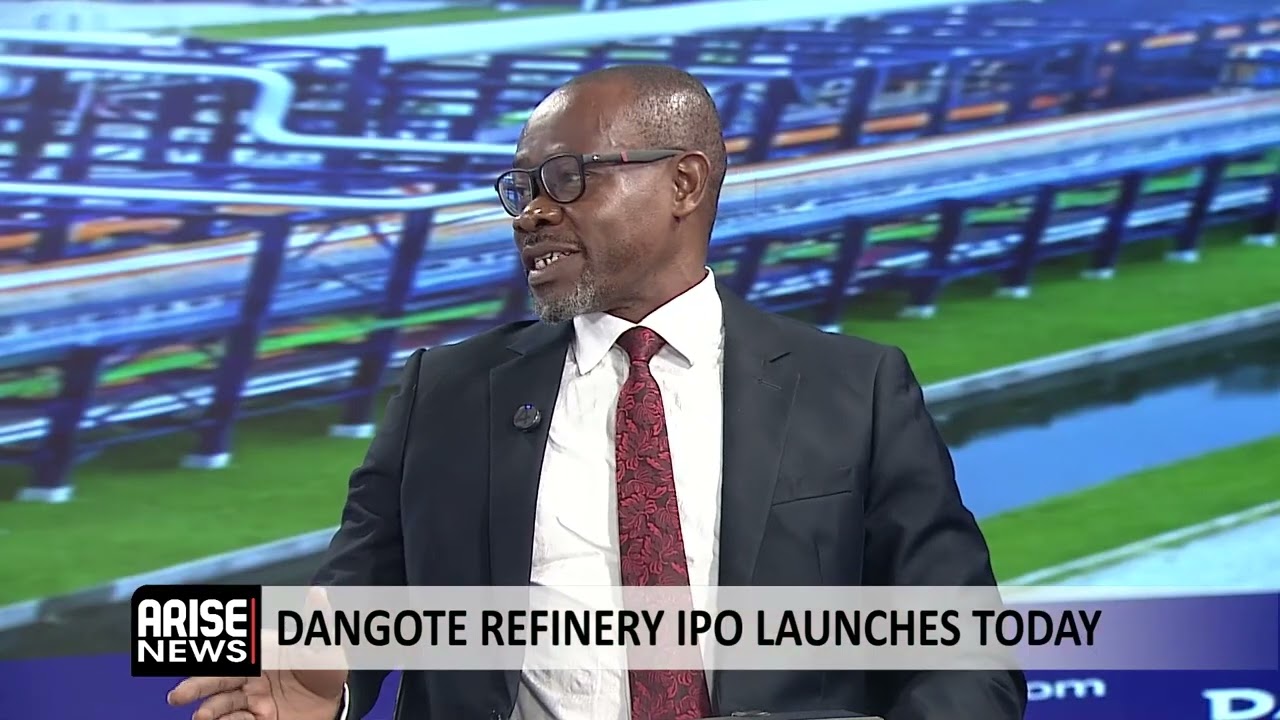
Professor of Economics and Business Intelligence at Lagos Business School, Bongo Adi, has said that the Dangote Refinery has become Nigeria’s second major breakthrough in the global value chain after the Nigeria LNG industry.
Speaking during an interview with ARISE NEWS on Monday, Adi said the refinery has moved Nigeria beyond exporting unprocessed raw materials by producing products that are consumed in other parts of the world. He said the development is also changing the conversation around Nigeria and Africa’s ability to compete in global manufacturing.
“So I will always argue that there are two companies that have put Nigeria near Africa in the global value chain. One is our NLNG, the second is now the Dangote Refinery.”
He said the refinery’s significance goes beyond its size. “What I mean by being in the global value chain is that what we are producing here is being consumed in other parts of the world, not just that we are sending unprocessed raw materials.”
Adi said the refinery is also changing how Nigeria’s industrialisation prospects are viewed. “And moreover, it has shifted the conversation around industrialisation and the ability of Nigeria or Africa to also feature in the manufacturing space globally.”
He compared the potential impact of the Dangote Refinery on Nigeria with the role played by NVIDIA in the United States economy. “But in terms of impact, I think we can compare Dangote today to NVIDIA. What NVIDIA is to the American economy and the rest of the world is what Dangote IPO is to us, in the sense that this is one company that seems to have really broken the ground when it comes to very difficult infrastructure space in the petrochemical industry as well.”
He also discussed the proposed public offering of Dangote Refinery shares, saying Nigeria’s stock market remains heavily concentrated, with only a small portion of shares available for public investors. “Because first, the stock market is still hugely concentrated. The free float, that is what people can buy, is less than 10% of the market.”
Adi said ownership of listed companies remains concentrated among a small number of investors and companies. “And again, it is largely owner-controlled.”
He said the concentration is particularly visible among the biggest companies listed on the market. “Almost 80% of the stock market is controlled by the top 20 companies.”
Adi said the structure means the Nigerian stock market does not yet provide broad access for citizens seeking to participate and benefit from investment opportunities. “So you can see where about less than 10% of the markets, OK, control everything. So it is not that egalitarian. It is not where everybody will seek to play and benefit.”
On fuel prices and subsidy, Adi said the government should reconsider its approach. “Given that we’ve managed to restore the economy and restore confidence and build up the external reserve and all that, the macroeconomics, I think it is about time to reconsider the subsidy.”
He rejected the argument that subsidy was responsible for Nigeria’s economic problems and said the previous system was poorly implemented. “If you do your analysis properly, you will see that subsidy was never the problem of Nigeria, the challenge that we had, even when subsidy was on, was that we implemented it the wrong way.”
Adi said the subsidy system allowed people who were not supposed to benefit from it to gain from the policy, while those who needed support were left out. “So there was such a huge spillover to people who shouldn’t have anything to do with subsidy, but everybody was benefiting from it. But the people who should really, whose subsidy should help, never get to benefit from it.”
He said the solution should be a targeted subsidy rather than the complete removal of support for consumers. “So we can have targeted subsidy. I think those are the things we need to address, not that we need to scrap subsidy.”
Adi also linked the removal of subsidy to worsening living conditions, saying the impact on ordinary Nigerians should be part of the economic debate. “My argument, because if you do the analysis properly, you will see that subsidy was never Nigeria’s problem, and then removal of subsidy has impoverished the masses and that is the argument that we need to have, and we shouldn’t shy away from it, regardless of what’s going on.”
He said governments have a responsibility to protect consumers when economic shocks threaten livelihoods. “Why we need subsidy? Because you need to defend the consumers. You need to defend the citizens at some point in time.”
Adi said other countries also use measures to protect consumers, particularly when energy prices rise sharply. “Europe, Germany, Italy, Indonesia, Malaysia, all these countries are defending their consumers in this currently, especially with the spike in oil price. Every government does that.”
He also pointed to the tax incentives available to the Dangote Refinery, saying the refinery has benefited from its status within a free trade zone. “But this refinery enjoys a level of tax subsidy because it’s in a free trade zone, until the new tax laws were changed.”
Adi emphasisied that the tax treatment is expected to change under new legislation. “Until the new tax laws are changed, now that from 2028, free trade zone, we’re paying taxes.”
“Currently they’re enjoying a free subsidy on taxation.”
He said companies benefiting from government incentives should also consider what they give back to the public. “So people enjoy pioneer status. Then what do they give back to the people? Yeah, they should give something back.”
On poverty, Adi said the economic gains being recorded have yet to translate into an improvement in the livelihoods of many Nigerians. “We have seen how poverty, you know, the trajectory of poverty over the past three years, it is not decreasing. It is actually increasing.”
He said the available economic indicators do not yet point to an imminent reduction in poverty.
“And everything going, so we haven’t seen any change in the relevant microeconomic indicators that will tell us that poverty will reduce anytime soon.”
“The way it is currently, it’s going to increase.”
Adi said improving Nigerians’ livelihoods would require a credible and accountable mechanism for putting support directly in the hands of ordinary people. The only thing that could make a dent on that microeconomic space is if something is given back. If there is a credible and accountable, right, enforceable way of shoring up the livelihood of the average Nigerian.”
Adi warned that without such measures, ordinary Nigerians may not feel the benefits of broader economic developments. “If that doesn’t happen, I don’t think they will benefit from any of this.”
He also called for flexibility in economic policymaking, saying the government should adjust policies when evidence shows that existing measures are not delivering their intended results. “You do not implement or go through economic policy in a unidirectional, you know, intransigent manner. When you look at the situation, analyse the data, you see that there is a need for you to change course.”
Adi described this approach as “problem-driven iterative adjustment”, saying economic policies should be reviewed as new data and outcomes emerge. “In economics also, it is called problem-driven iterative adjustment. When you embark on a policy stance, and then you have achieved some objectives, some have not been achieved, you need to reevaluate, reassess the situation in the light of new data.”
He said this does not mean returning to the old subsidy system but finding ways to protect Nigerians without distorting the market. “We’re not saying they should bring subsidy back the way it was. But are the citizens entitled to some sort of subsidy from the government? There is no question about that. They are, but we have to find creative ways of doing it in such a way that it does not distort the markets.”
Erizia Rubyjeana
Follow us on:


