


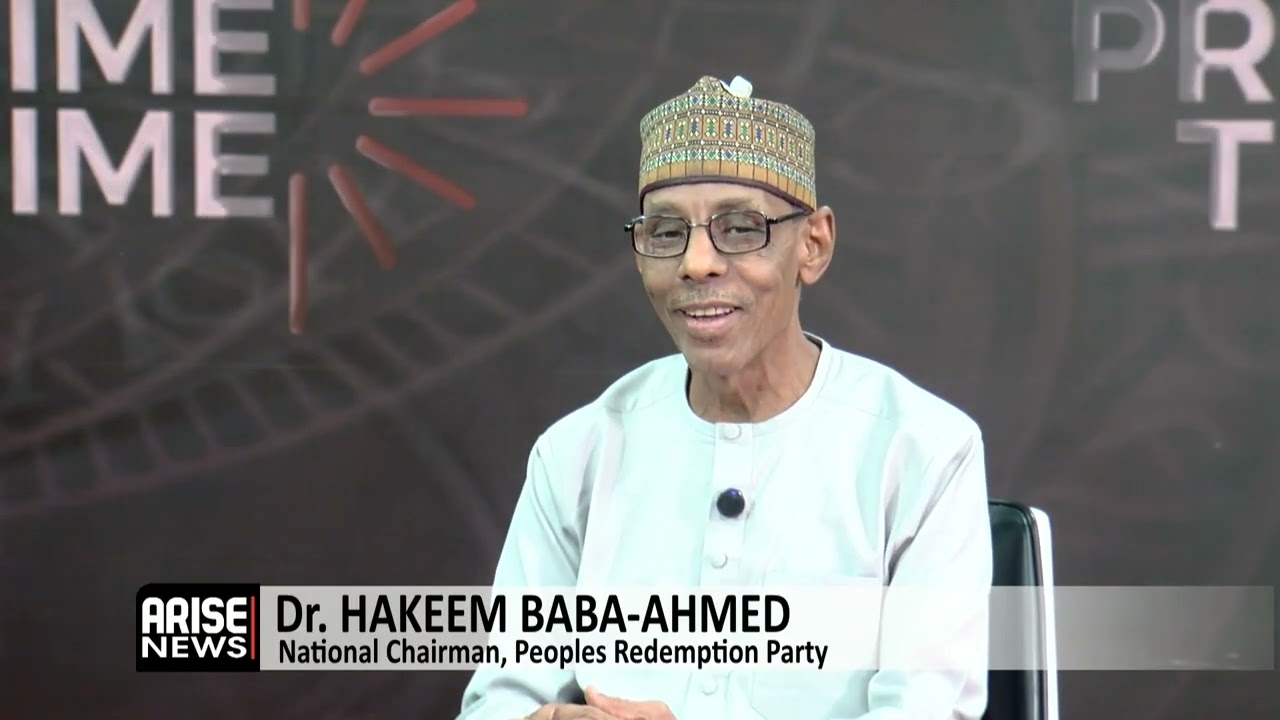
The national chairman of the People’s Redemption Party, (PRP), Dr. Hakeem Baba-Ahmed, has said opposition parties must pool their resources, protect one another and strengthen their collective capacity to oust the All Progressives Congress (APC) in the 2027 elections.
Speaking with Arise News in an interview on Wednesday, the PRP chieftain said the coalition should entail opposition parties working together and pooling their energy and resources to strengthen their challenge to the ruling APC.
“It’s to be designed basically to improve the capacity of opposition parties to oust the APC. Plainly speaking, that’s it. It entails working together, pooling energy and resources together.
“Parties have become factionalized; you just never know whether some candidates will be on the ballot or not, or if their particular faction of the party is not recognized at some stage between now and then. You don’t know whether they will be on the ballot or not. That’s how uncertain things are. This is one of the reasons why we need this coalition. We need to watch each other’s backs, protect each other, give each other support, and raise our voices on the need to meticulously respect the law of the land.”
On the question of a unified presidential candidate, Baba-Ahmed said it would be difficult for the coalition to adopt a single candidate at this stage, noting that all the parties already have candidates.
He, however, said “all options are on the table”, including supporting a candidate without asking other candidates to withdraw or allowing multiple candidates to contest while the parties reinforce one another in other ways.
“Technically, it would be very difficult to simply say we have one candidate. All the parties in the coalition now have candidates. The period when you could have said to coalition parties, ‘Okay, you don’t need a candidate, we have one,’ is over.
“However, there are a lot of things we can do. All options are on the table. We can support a candidate without necessarily telling our candidates to stand down, or we can allow multiple candidates to contest. But there are many other ways in which we can reinforce each other.”
On the strength of the APC ahead of the 2027 elections, Baba-Ahmed identified money, security and political hostility as major factors, but expressed confidence that Nigerians facing prolonged hunger and hardship would not be swayed by last-minute financial inducements on election day.
“The muscle of the ruling party is, for all appearances, massive, massive money. Money is going to be a major determinant of the elections. You’re not likely to see millions of rallies that have hundreds of thousands of people. Security is a major factor, hostility is a major factor, and the deteriorating security environment and hostility between political parties are major issues.
“There’s a lot of anger in the land. I think people are wiser now. You can’t give them enough money to make up for two to three years of desperate hunger and desperation and get them to vote for you. Sadly, the APC has pushed Nigerians to such levels of desperation that just giving them a little bit of money on election day or two or three days before the election just won’t do it.”
Dismissing the size of APC rallies as a measure of electoral support, Baba-Ahmed alleged that large crowds could be mobilised for rallies without necessarily translating into votes, arguing that the impact of insecurity and poverty over the past three years had profoundly affected Nigerians.
“They have populations, but they are also a rented crowd. It’s very easy to rent. You can rent a voter, but I think voting is a different thing from attending a rally. You’re talking about two, three, four years. These last three years have been profoundly influential in the way people live. In many parts of this country, the combination of security issues and poverty has really affected the population in very profound manners. I think that we’re dealing with a different type of population now,” he said.
Speaking on the need for opposition parties to work together, Dr Baba-Ahmed said the coalition had become necessary amid legal challenges and factionalisation affecting several parties, noting that five or six of the eight or nine parties in the coalition were currently facing court cases.
“it’s one good reason, particularly where it’s established that some of them have been unfairly treated, where we see some evidence of playing the law or tweaking with guidelines just simply to keep some candidates or factionalized parties out.
“In the coalition that we have now, we have about eight or nine parties. Five or six all have court cases. We’ve settled ours now, but others have even more profound challenges.”
Baba-Ahmed also alleged that the ruling party had been involved in “playing dirty”, saying there was sometimes evidence to support claims of unfair treatment and manipulation of electoral guidelines.
“We know that the APC is not particularly innocent when it comes to playing dirty. We have evidence sometimes that supports this kind of thing, but I would say we don’t sleep with both eyes closed, and other parties don’t either.”
Insisting on the need for a collective opposition strategy, Baba-Ahmed said no opposition party, including the bigger ones, could defeat the APC alone, citing the ruling party’s financial resources, incumbency and political structures.
He said the emerging coalition of about eight parties was developing into a major force, with efforts to ensure the ADC and NDC remained actively involved.
“Anybody who thinks that they alone—any party out of the 18 or 19 parties—who thinks it alone, including the big ones, can take on the APC and win is living in another world. That’s the truth. They just don’t have the money or the muscle; the ruling party has the entire government on their side, they have everything you need.
“We have a coalition that is emerging now into a major force. There are about eight parties. The ADC and the NDC.Right now, it’s a coalition of parties. Candidates, of course, are important; these are their fates, their futures, so we don’t want to negotiate them away.”
Baba-Ahmed disclosed that the emerging coalition was working to establish a common identity and policy priorities before resolving the question of presidential candidates, to avoid internal disputes undermining the alliance.
He said the coalition wanted to present Nigerians with a clear programme focused on insecurity, poverty, economic management, youth opportunities, corruption and reforms to the structure of the Nigerian state.
“What we’ve decided to do for now is establish the parameters of some kind of unity that can survive a lot of the challenges that will face us as a coalition. Then, the candidates come in. We need to do that; otherwise, the quarrels over which candidate, how many candidates, or whether anybody stands down for anybody will just wreck it up. This is the honest truth, and we have succeeded in doing that.
“Parties are coalescing, we are establishing working groups, and we are trying to establish an identity. We want Nigerians not just to see us as seeking to replace President Tinubu, but also because there are things we can challenge them on that we will do for the next four years after 2027. We are not just a coalition of parties that are ambitious to get power; there are specific things we will do, and we are beginning to identify those as issues that will represent our priorities for the nation.
“One of them is that we want a leadership that understands where the problems we have are coming from. We live with them all over the place. There must be an understanding of why we are so weak as a country and why all these insecurities are coming in. There is clearly incompetence in the management of the economy and a failure to understand why there are such high levels of poverty.
“We want to see what we can do about the structure of the Nigerian state, the key values of the system, and how you deal with corruption.”
Favour Odima
Follow us on:


