


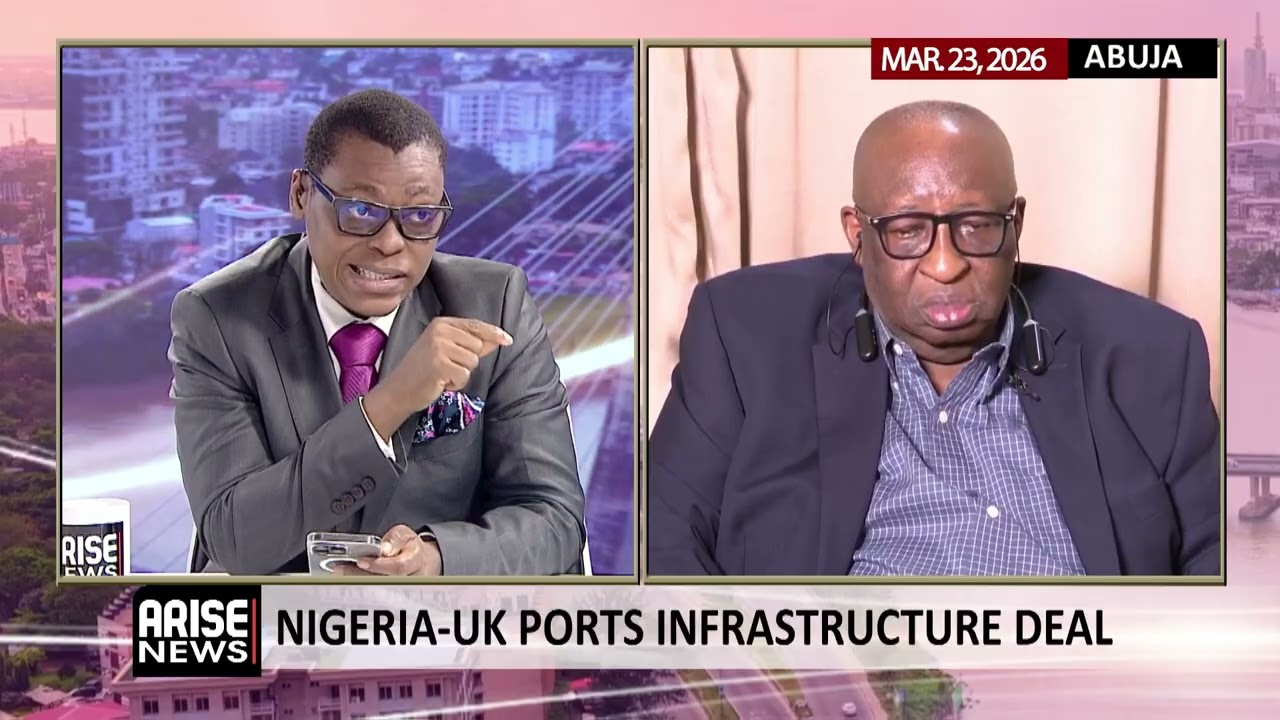
Economist Professor Akpan Ekpo has warned that Nigeria’s recent port infrastructure agreement with the United Kingdom could plunge the country into long-term debt while delivering limited economic benefits to Nigerians.
Speaking in an interview on ARISE NEWS on Monday, Ekpo described the deal as skewed in favour of Britain, arguing that it reflects a broader pattern of unequal economic relations rooted in Nigeria’s colonial history.
“The British government has been very clever. They’ve turned economic diplomacy upside down and reinforced our neocolonial status,” he said.
Ekpo raised concerns that a significant portion of the deal—reportedly involving hundreds of millions of pounds—would flow back to British firms, including contractors and steel producers, leaving Nigeria with debt obligations.
“At the end of it, Nigeria will be in debt. The so-called job creation will be jobs for the British, not for Nigerians,” he stated.
He argued that the agreement could revitalise struggling sectors in the UK economy, particularly its steel industry and financial institutions, while offering minimal local value.
“All the equipment needed to upgrade the ports will come from Britain. There is not much gain for Nigerians,” he added.
The economist questioned why Nigeria continues to rely on foreign inputs instead of revitalising its dormant steel industry, including Ajaokuta Steel Mill and other rolling mills.
“We have a steel industry that has collapsed. Instead of revamping it, we are signing deals to import steel,” he said.
He stressed that such decisions undermine domestic capacity and perpetuate dependency.
Ekpo criticised the lack of transparency surrounding the agreement, including the absence of clarity on loan terms, procurement processes, and contractor selection.
“There is no transparency in this deal. We have not seen the terms of the loan—the interest rates, the moratorium, or the conditions,” he said.
He suggested that agreements of this magnitude should be subjected to parliamentary scrutiny before approval.
“In some countries, such deals would be sent to parliament for debate. Our representatives should examine whether this is in the national interest,” he noted.
Ekpo also expressed doubts about the competence of the Nigerian firm reportedly awarded the contract, suggesting it may rely heavily on foreign expertise.
“The contractor does not have the competence. They will go back and engage foreign experts to do the work,” he said.
He added that the procurement process itself appears flawed, noting that it is unclear whether the contract was competitively tendered.
“Was the process advertised? Were bids invited? We didn’t see that. The process itself is faulty,” he argued.
Beyond financial concerns, Ekpo criticised the concentration of port development projects in Lagos, warning that it could worsen regional inequality.
“A country must have a balanced development strategy. Why focus only on Lagos when there are other viable ports across the country?” he asked.
He pointed to underutilised ports and deep-sea facilities in other regions, stressing the need for a more inclusive national infrastructure plan.
Ekpo cautioned that poorly structured agreements could saddle future generations with unsustainable debt.
“When you sign these economic deals, you are mortgaging the future of citizens. Generations of Nigerians may end up paying for this,” he said.
While acknowledging that the agreement may already be in motion, Ekpo urged the government to revisit the terms and provide full disclosure to Nigerians.
“The presidency must come out clearly and explain what went on, how the contractor was chosen, and what the benefits are for Nigeria,” he said.
He maintained that without proper scrutiny and expert input, such deals risk deepening economic dependency rather than driving sustainable development.
“As it stands, this is not a win-win situation. It does not benefit Nigeria at all,” Ekpo concluded.
Boluwatife Enome
Follow us on:


