


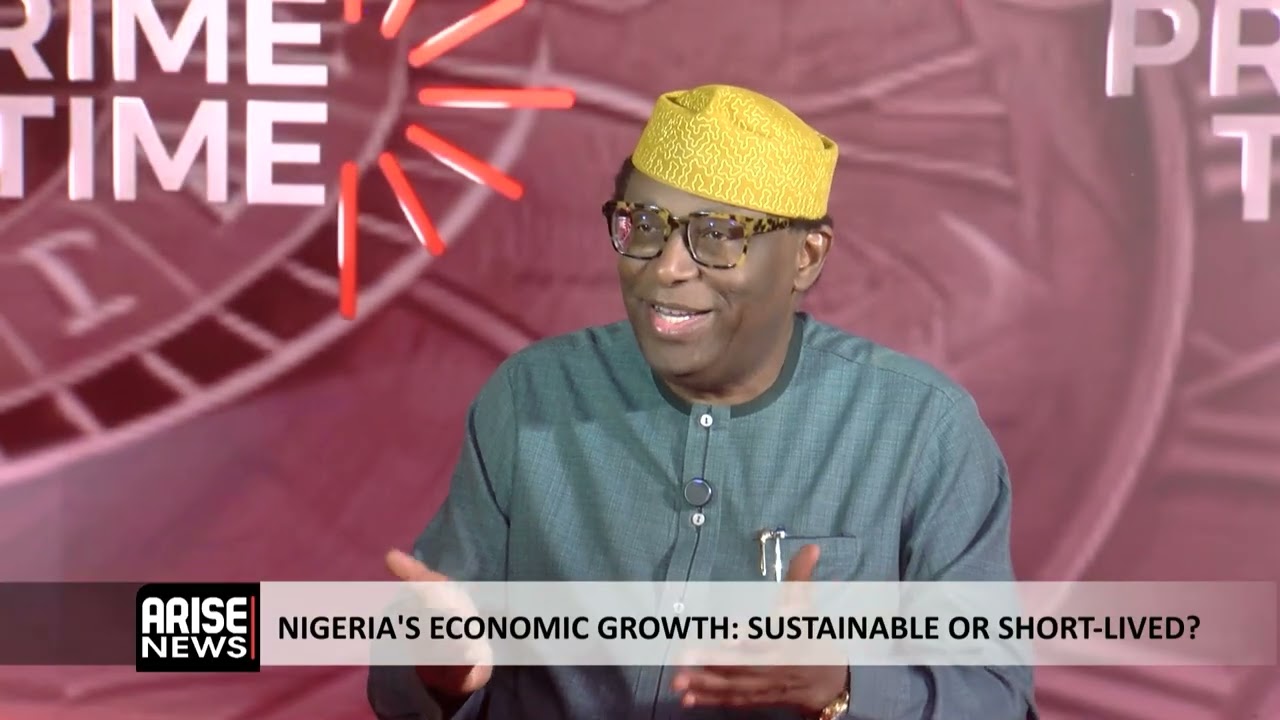
Investment banker, economist, and CEO of CFG Advisory, Adetilewa Adebajo, has said that for Nigerians to feel the impact of ongoing reforms, 8-10% economic growth has to be achieved.
He said this in an interview with ARISE NEWS on Thursday.
“For Nigerians to begin to feel the impact of these reforms, the economy has to grow between 8% to 10% on a sustainable basis. The government has to put in those growth strategies in place to hit those numbers. 5% is good; it’s larger than the growth of population, but for a population of 200 million Nigerians, we need to see sustained growth at about 8% to 10%”, he said.
He added: “I think there’s no doubt that the economy has reached a point of inflection, and we’re beginning to see more than ‘green shoots.’ But of course, reforms by themselves are not enough to be able to make things work. In order for us to see the impact on the lives of Nigerians, we have turned our economy into a ‘sachet economy’, and we have about 120 million Nigerians in multi-dimensional poverty. So, the urgency of now is that we need to translate the gains of these reforms into sustainable and solid growth and productivity.”
Adebajo also said that Nigeria is experiencing a meaningful slowdown in inflation, though prices remain high for consumers.
“If you take a look at prices and the trajectory of inflation over the last year, we’ve seen a significant decrease in inflation. While official numbers are at about 15%, we at the CFG Advisory, using our adaptive gap analysis, still put inflation around 18%. You think that the sentiments of the Monetary Policy Committee, they do not have the confidence to cut rates at that level yet because they are being more conservative and want to be sure.
“But I think officially we should reach single-digit rates at this run rate of disinflation. Inflation by the end of this year should be close to about 10% or 12%. In 2012/2013, Nigeria hit growths of between 8% to 10% when inflation was at 12%. So, that’s a magic number for us. If we can get inflation down to 11% or 12%, I think we can begin to see significant growth. But growth has to be deliberate; government has to put in the stimulus to grow the economy”, he explained.
Speaking on whether it is the right time for the CBN to cut rates at the risk of reigniting inflation, Adebajo said:
“Well, they should, because while the Central Bank is having a cautious approach, evidently the real sector cannot continue to borrow at 30%. It’s not a growth enhancer where the rates are right now. The beneficiaries of the rates are the investors making good profits, but we need to strike a balance and have an equilibrium whereby the rates will come down so real sectors can borrow to stimulate growth.”
The investment banker also noted Nigeria’s FX market is now largely market-driven, with the CBN playing a minor role, while foreign inflows and limited interventions help stabilise the naira.
“We do have a market-driven system, without a doubt. Last year, we had $25 billion in Foreign Portfolio Investment (FPI) flows. We have diaspora remittances of close to $30 billion. What this has done is that the Central Bank of Nigeria is no longer the dominant player in the market.
“From the statistics I’ve seen, the Central Bank’s participation in the market is under 10%. As of the end of last year, it was about 6%. So, the Central Bank is just another player in the market, and we’ve been able to diversify the sources of our foreign exchange. The critique of the Central Bank is that they did an intervention last week of about $200 million; I don’t know what it’s for. But we should not forget the Central Bank also needs dollars and Naira to fund the FAAC accounts to pay the states. I think the critique of the Central Bank was that they didn’t let the Naira drop further down. If they hadn’t done that intervention, probably the Naira would be trading at 1,002. But what is important is that we have a market-driven system which is open and transparent”, he explained.
Responding to concerns whether the exchange rate level is sustainable, Adebajo said:
“I think it’s extremely sustainable in the sense that the fundamentals are clear. We have reserves at close to $50 billion. The key is the supply. The Central Bank is no longer the main supplier. We need to keep the market liberal so portfolio investors, diaspora remittances, and exporters continue to bring money into the system to build confidence.”
Adebajo further said that Nigeria’s current budget is not sustainable, and he recommended a major restructuring where the three budgets are consolidated.
“Even with the increase in taxes, you cannot fund the deficit. This increase in tax cannot cover the budget deficit. So, we need to restructure the budget. I made a presentation recently at the Senate Appropriations Committee, and it was decided that all these three budgets we have must be consolidated and streamlined this year”, he shared.
Adebayo also noted that despite successes from recent economic reforms, Nigeria still faces major fiscal challenges.
“Every single reform has ‘worked’ technically. We removed the subsidy and are saving $15 billion a year. But unfortunately, we are running a 25 trillion naira deficit. The irony is that the debt service burden is about 15.9 trillion naira. That debt service burden is larger than the defense, infrastructure, power, education, and health budgets combined, which total 15.2 trillion.
“That really is where the challenge is today. While we might have benefited from the reforms, we have significant fiscal challenges. The banking recapitalization is important; all banks in Nigeria are fundamentally sound. We’re asking them to decide how they want to play, internationally, nationally, or regionally.
“We’ve built a solid foundation, but reforms alone cannot make it happen. I don’t believe Nigeria is just a $1 trillion economy; the potential is a $3 trillion economy. But we do not have the economic leadership to get us there. We need structural reforms to translate gains into 8% to 10% annual growth to bring 120 million Nigerians out of poverty”, he explained.
Favour Odima
Follow us on:


