


A Professor of Communications at the Baze University, Abuja, Abiodun Adeniyi, has described Vice President Kashim Shettima’s call at the United Nations General Assembly for two permanent African seats on the UN Security Council as legitimate, arguing that Africa’s exclusion from consequential global decision-making no longer reflects contemporary realities.
Vice President Kashim Shettima has renewed Nigeria’s call for a more representative United Nations Security Council, demanding two permanent seats for Africa with veto rights to reflect the continent’s role in global affairs and ensure its interests are represented in decisions affecting the international community.
“The demand is very legitimate. The Security Council was constituted on the back of the conclusion of the Second World War after the failure of the League of Nations. When it was constituted, most African nations, including Nigeria, were still under colonial rule.
“About 60 years later, the world has evolved. Some rethinking needs to be injected into the membership of the Security Council because decisions are made that affect the globe, and those who are directly or indirectly affected are excluded from the decision-making process. Redefinition is necessary,” he said.
Adeniyi, however, said Nigeria’s pursuit of a permanent seat must be matched by stronger domestic fundamentals, including economic performance, political stability, improved governance and sustained efforts to address insecurity.
He identified Nigeria, Egypt, South Africa and Morocco as among the African countries with strong claims to greater representation, citing their economic strength and visibility on the global stage.
“While we are agitating for membership as a nation, a nation’s global reputation is defined largely by domestic policies, domestic stability, and sustainability. We need to strengthen our own internal configuration. Our economy has to be better, how we strive to meet the aspirations of the people must be enhanced, and issues like insecurity have to be addressed so the world can see us in a better light.
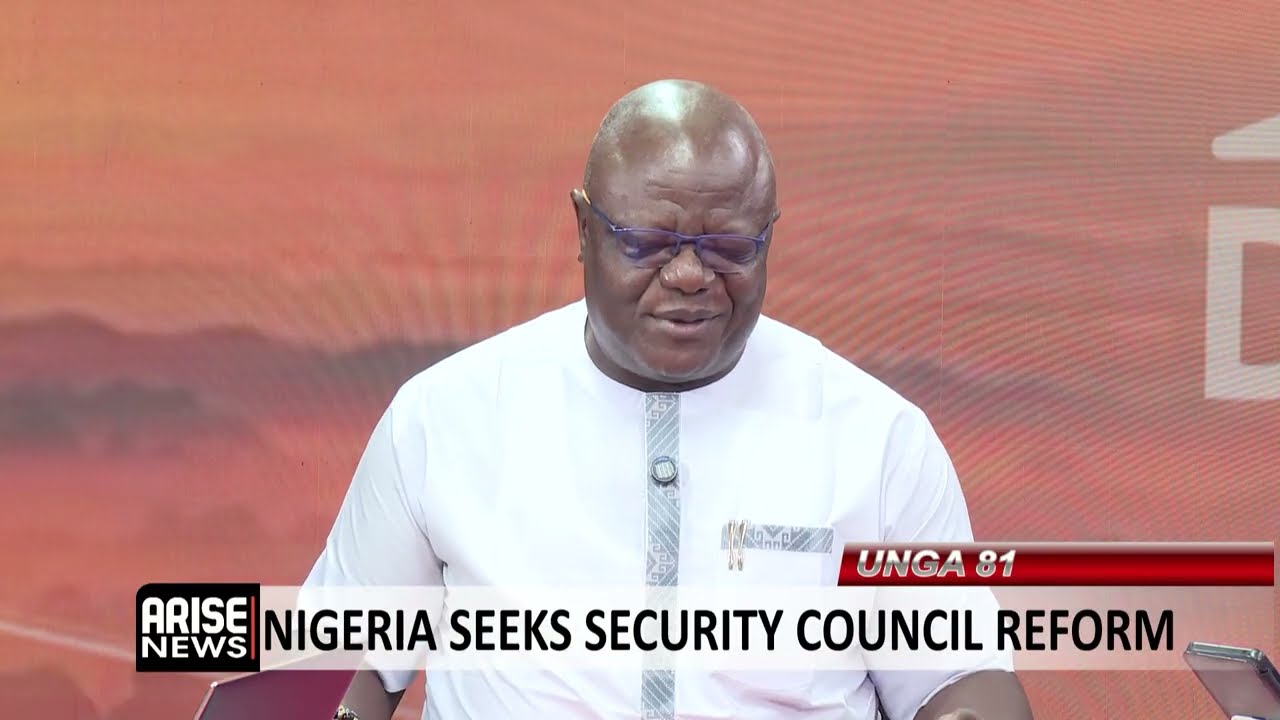
“Beyond that, we also have to look at the African countries agitating for it. Nigeria, Egypt, South Africa, and Morocco are among the strongest African countries. These countries have legitimate claims on account of their economic strength and visibility in the world.”
On the prospects of achieving the reform, Adeniyi acknowledged that the chances may be slim but maintained that Nigeria and other African countries must sustain the agitation for greater representation at the global level.
“The fact that the possibilities are slim does not mean we should not sustain our agitation. Nigeria, Egypt, and South Africa contribute to global GDP. Even if our economy is in a precarious condition, it doesn’t mean we can be undermined, because we remain a market for many developed nations.
“We have to keep hope alive and not rest on our oars regarding agitation and making constant pronouncements. The fact that we are repeating them is a reminder of the importance of the subject matter.”
Turning to Africa’s struggle to process its natural resources, Professor Adeniyi attributed the challenge partly to weaknesses in leadership and declining confidence among Africans in the continent’s capacity, saying stronger leadership and greater faith in Africa could boost productivity, manufacturing and its position in global competition.
“It is an expansive subject, but we can start from the attitude of African leadership and, by extension, the African people. When we talk about African leadership, we shouldn’t just zero in on presidential leadership. We should be mindful of the increasing faithlessness of Africans leading to mass migration.
“Each time migration is discussed, the continent referenced is Africa. When movement of people is discussed in other sections, terms like ‘expatriates’ or ‘foreign investors’ are used. We must not lose sight of the weakness in African leadership and people, evidenced by the increasing decline in their ability to invest faith in their own continent.
“If attempts are made to ramp up effort, if there’s increased faith and hope in leadership, and if leadership galvanises the people, the narrative could change. Attitude impacts productivity and manufacturing, and people will rate you differently.”
Speaking on what Nigeria must address domestically in order to strengthen its claim to a permanent seat, Adeniyi identified insecurity, corruption and weaknesses in the political process as key concerns that must be tackled to improve the country’s global standing.
“First, we need to look at Nigeria as a nation that is well qualified. Our economy is one of the strongest in Africa.
“Questions around insecurity, corruption, leadership, and the political process need to be resolved.
“By the time we look at these things, even if we are not completely able to achieve it, if the optics are right and there is proper symbolism in a positive direction, we will be regarded better and nobody will dispute our qualification to become a member of the Security Council,” Adeniyi said.
On the impact of insecurity on attracting investment, Adeniyi noted that capital tends to avoid crisis-prone environments, stressing that Nigeria must improve security, transparency and credibility in transactions and procurement to restore confidence in the country.
“There is a saying among economists that capital runs away from crisis. You do not want to put your investment in a place deep in crisis.
“To have thriving manufacturing and productivity, you need to show that your environment is peaceful, much like it was in the 80s and 90s before multinational companies started exiting Nigeria. Their exit means there’s no confidence in the environment.
“It isn’t rocket science. We need to upping the ante, do the right things in action and not just pronouncements. The lack of transparency and credibility in transactions and procurement processes has to be minimized so people know we are moving in the right direction.”
Adeniyi said Nigerians should remain hopeful while recognising the importance of diplomacy and dialogue in highlighting unresolved issues and reminding leaders of the work that remains to be done.
“It is okay to be hopeful and think appropriately that all will be well. Discussions and diplomacy cannot be undermined. They serve as activities that prick consciences and let us know there are still miles to cover and things left undone that have to be done.”
On Nigeria’s history of representation at the UNGA, Professor Adeniyi agreed that the statistics were noteworthy, but citing Ambassador Joe Keshi, stressed that the key issue was ensuring Nigeria remained fully represented and visible in global discussions.
“It is a correct observation. Recently, Ambassador Joe Keshi said what matters is that Nigeria was fully represented and not lost in conversation. For now, we can rest our case with that.”
Favour Odima
Follow us on:


